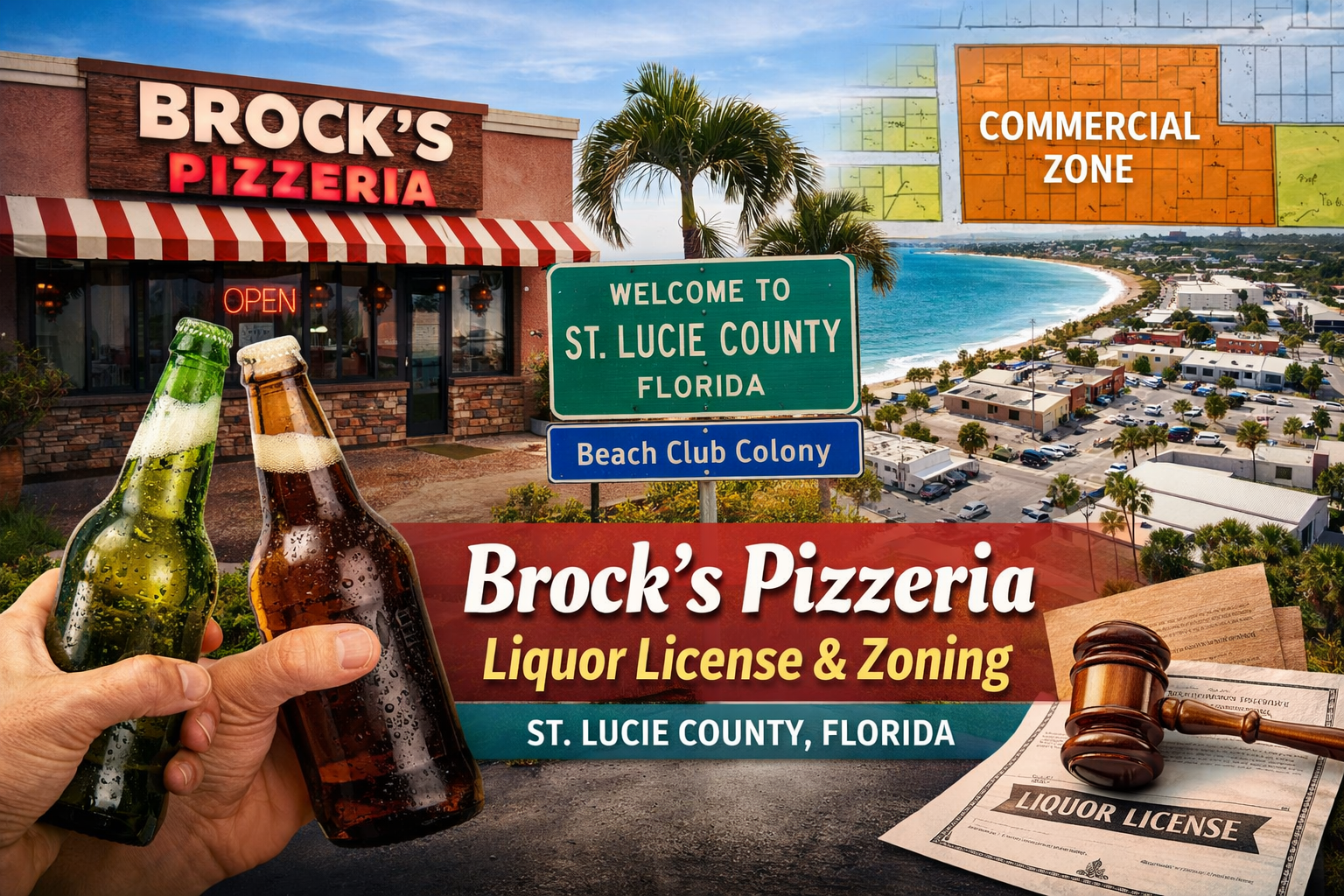
Brock’s Pizzeria has been a staple of the St. Lucie community for three decades, but their recent request for a “conditional use permit” to serve distilled spirits proved that even a beloved local business must navigate complex zoning waters to grow.
The Request for Growth
The owners of Brock’s Pizzeria appeared before the board to request a text amendment that would allow them to serve hard liquor alongside their beer and wine. They argued that after 30 years, their loyal customer base was asking for more variety—specifically, the ability to enjoy a cocktail with their dinner. To facilitate this, the county had to consider a broader change to the “Commercial Neighborhood” (CN) zoning, which typically limits small restaurants from having a full liquor bar.
The Neighborhood Pushback
The request was met with significant opposition from the neighboring Beach Club Colony. Residents were not necessarily opposed to a “martini,” but they were deeply concerned about the “spirits of the night.” Residents voiced frustrations over existing “back of house” issues, including delivery trucks blocking residential lanes and employees parking in front of homes on Los Olas Drive.
A Conditional Compromise
The Planning & Zoning Commission found a middle ground. They recommended approval, but only with a set of “heavy strings” designed to protect the peace of the residential neighbors:
- Closing Time: The restaurant must close by 10 PM.
- Spirit Sales: Hard liquor can only be served between 7 AM and 10 PM.
- Physical Barriers: The developer must install a landscape island and close a specific “fence gap” to ensure restaurant patrons and staff stay on the commercial side of the property line.
What This Means for Local Business This case highlights the “Conditional” in Conditional Use Permits. St. Lucie County is open to business growth and evolving menus, but only if the business can prove it won’t let its success spill over into the quiet streets of the surrounding neighborhoods.
Brock’s Pizzeria has been a staple of the St. Lucie community for three decades, but their recent request for a “conditional use permit” to serve distilled spirits proved that even a beloved local business must navigate complex zoning waters to grow.
The Request for Growth
The owners of Brock’s Pizzeria appeared before the board to request a text amendment that would allow them to serve hard liquor alongside their beer and wine. They argued that after 30 years, their loyal customer base was asking for more variety—specifically, the ability to enjoy a cocktail with their dinner. To facilitate this, the county had to consider a broader change to the “Commercial Neighborhood” (CN) zoning, which typically limits small restaurants from having a full liquor bar.
The Neighborhood Pushback
The request was met with significant opposition from the neighboring Beach Club Colony. Residents were not necessarily opposed to a “martini,” but they were deeply concerned about the “spirits of the night.” Residents voiced frustrations over existing “back of house” issues, including delivery trucks blocking residential lanes and employees parking in front of homes on Los Olas Drive.
A Conditional Compromise
The Planning & Zoning Commission found a middle ground. They recommended approval, but only with a set of “heavy strings” designed to protect the peace of the residential neighbors:
- Closing Time: The restaurant must close by 10 PM.
- Spirit Sales: Hard liquor can only be served between 7 AM and 10 PM.
- Physical Barriers: The developer must install a landscape island and close a specific “fence gap” to ensure restaurant patrons and staff stay on the commercial side of the property line.
What This Means for Local Business This case highlights the “Conditional” in Conditional Use Permits. St. Lucie County is open to business growth and evolving menus, but only if the business can prove it won’t let its success spill over into the quiet streets of the surrounding neighborhoods.