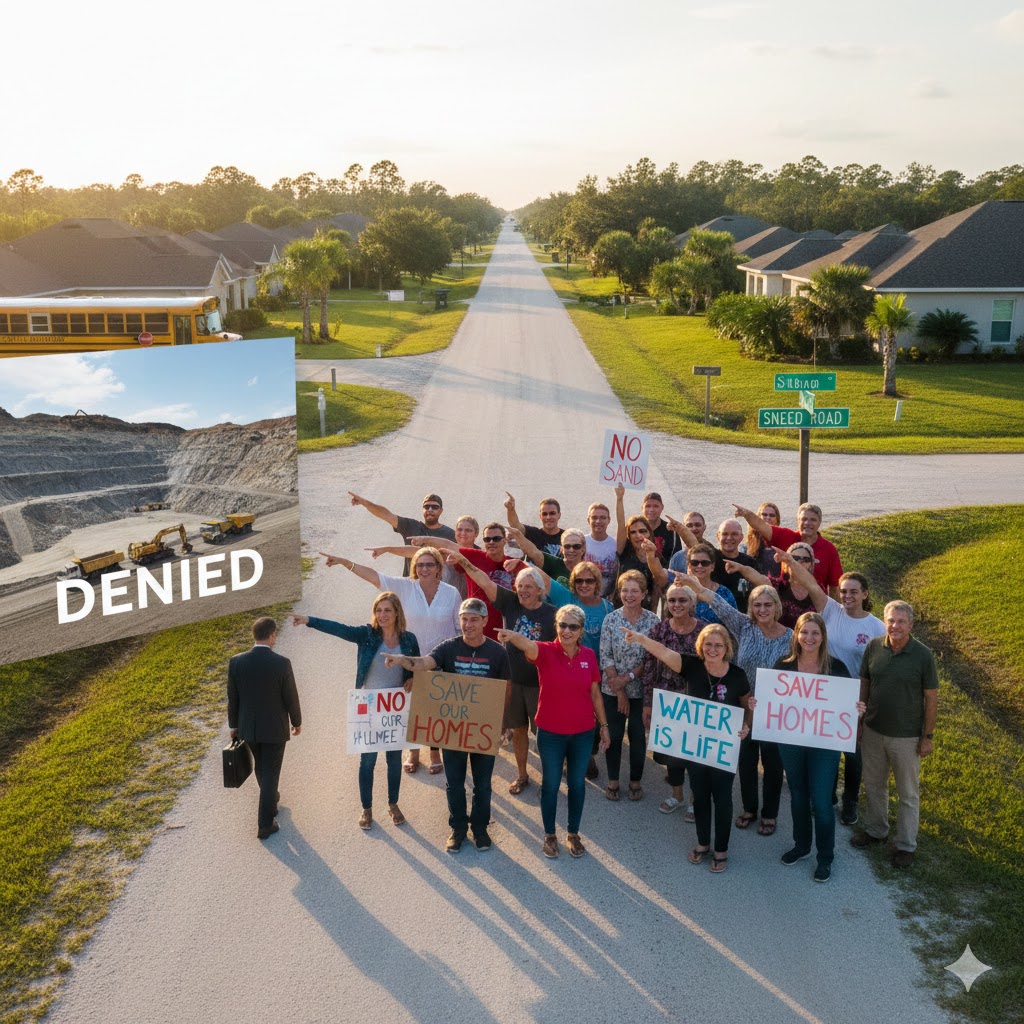
In a powerful demonstration of community-driven planning, the St. Lucie County Planning & Zoning Commission recently issued a unanimous recommendation for denial regarding the proposed Piera Sand Mine on Sneed Road. This decision marks a significant moment for the “Rural Ag” residential corridors of the county, proving that even substantial infrastructure offers cannot always bridge the gap between industrial utility and neighborhood compatibility.
The $1 Million Proffer
The applicant, Piera Properties, presented a compelling financial case. They proposed a 77-acre sand mine that would eventually result in a 44-acre lake donated back to the county for public or environmental use. Recognizing the “inferior” state of Sneed Road, the developer also offered to fund a $1 million widening and improvement project for the roadway. In many cases, such a proffer is a winning ticket for approval, as it solves a long-standing county infrastructure deficit at no cost to the taxpayer.
The Voice of the Neighborhood
However, the residents of the Sneed Road area turned out in record numbers to present a different reality. For those living in the surrounding large-lot residential estates, the mine represented a fundamental threat to their quality of life. The primary concerns were twofold: safety and environmental security. Residents described the potential for a “NASCAR of dump trucks,” with estimates suggesting up to 200 heavy vehicle trips per day on a road frequented by school buses and local commuters.
Furthermore, the environmental stakes were personal. Because the area relies on private wells, the prospect of 24/7 dewatering pumps for a 50-foot-deep mine raised the terrifying possibility of local wells running dry.
The Board’s Stance
The Planning & Zoning Board echoed these concerns. While members acknowledged the county’s need for sand and the benefit of road improvements, they ultimately ruled that the “industrial nature” of a mining operation was fundamentally incompatible with the established residential character of Sneed Road.
Investor Takeaway
For real estate investors and developers in St. Lucie County, this denial serves as a critical case study in “compatibility.” It reinforces the idea that in 2025 and 2026, the county is prioritizing the protection of rural residential zones over aggressive industrial expansion into non-traditional areas.